The Core Component Fabricators: NAND Flash Producers
The Dominant Trio: Samsung, SK Hynix, and Micron
The NAND flash oligopoly centers on three firms: Samsung, SK Hynix, and Micron. When you ask who makes nvme drives, the answer begins with these fabricators because they produce the storage medium itself. Samsung controls roughly one third of the market, while SK Hynix and Micron add substantial volume, each investing heavily in advanced process nodes.
These companies do not merely assemble components; they manage the entire vertical chain from wafer fabrication to packaging. This vertical integration explains their dominance over the SSD market. A typical enterprise nvme drive contains NAND dies sourced from one of these three suppliers, regardless of the branding. So exploring who makes nvme drives always leads back to this trio.
The Japanese Powerhouse: Kioxia (formerly Toshiba Memory)
Think of Kioxia as the quiet brainiac of flash memory. This Japanese powerhouse, formerly Toshiba Memory, invented NAND flash back in the 1980s. While the big three grab headlines, Kioxia fabricates a huge share of the NAND dies inside branded NVMe drives. So when you ask who makes NVMe drives, Kioxia is half the answer. Their BiCS flash process pushes storage density forward. Here is what they handle well:
– Advanced 3D stacking
– High endurance cells
– Enterprise grade reliability
Without them, the market would look far less interesting. Their drives appear in gaming laptops and massive data centers alike. Next time someone quizzes you about manufacturers, drop the Kioxia name.
China’s Disruptive Contender: YMTC (Yangtze Memory Technologies)
China’s YMTC, or Yangtze Memory Technologies, is the newcomer shaking up the NAND market. While the established players refined their processes over decades, YMTC jumped straight to 3D NAND with their Xtacking architecture. This approach stacks memory cells and control circuitry separately, then bonds them together. The result is faster data transfer and better power efficiency, which matters when you are asking who makes NVMe drives for budget-conscious builds.
YMTC’s rise has been rapid, though not without turbulence. They have faced export controls and legal battles, yet their drives keep appearing in consumer SSDs and enterprise gear. Their pricing strategy has forced competitors to drop prices, which benefits anyone shopping for storage.
Here is what YMTC brings to the table:
- Xtacking 3D NAND architecture
- Aggressive pricing on high-capacity drives
- Rapid iteration cycles
When you ask who makes NVMe drives, YMTC is the name that keeps incumbents honest.
How NAND Flash Supply Influences NVMe Drive Pricing
Few components swing in price as violently as NAND flash. Every NVMe drive begins with these tiny memory cells, and the fabricators who make them set market conditions. When a factory yields poor wafers or shifts to a new production node, supply tightens.
The sequence plays out like this:
- Wholesale NAND prices climb as scarcity appears
- Drive manufacturers adjust retail pricing
- Consumers face higher costs for equivalent capacity
So when people ask who makes NVMe drives, the answer reaches beyond the brand on the label. I track these supply shifts closely, and they move fast! Strong fabrication output keeps pricing steady. A producer with weak fab output forces costs onto consumers, which is why understanding the component level helps you anticipate price swings. This dynamic reaches every retail shelf in South Africa.
The Brains of the Drive: NVMe Controller Manufacturers
Samsung’s In-House Controller Engineering
Most people think the NAND flash defines an SSD. It does not. The controller is the hardware that directs every read and write, and Samsung designs its own in a closed loop. That internal engineering means the firmware, wear leveling, and host interface speak the same language without negotiating with a third party.
Samsung’s in-house Elpis controller family handles simultaneous read and write requests with aggressive caching algorithms. This custom silicon pushes data rates beyond the PCIe 4.0 ceiling while keeping thermals in check. It explains why their drives often outperform rivals using off-the-shelf controllers.
When you ask who makes NVMe drives, the answer rarely ends at the NAND fabricator. For Samsung, the controller is a strategic asset, not a commodity part. This ownership changes how the drive behaves under pressure, which matters more than the sticker on the box!
Phison and Silicon Motion: The Third-Party Specialists
Ask who makes NVMe drives and the response often lands on two Taiwanese specialists, Phison and Silicon Motion. They do not produce NAND flash. They design the chips that coordinate every read and write, and their silicon sits inside drives from Corsair, Seagate, Kingston, and dozens of smaller brands.
Phison targets the performance tier with its PS5026 and newer PCIe 5.0 controllers. Silicon Motion captures the mainstream segment with the SM2264 and its successors. Both companies ship complete firmware with the hardware, so a brand can assemble a reliable SSD without building its own storage stack.
- Phison leads in high-end consumer and enterprise designs
- Silicon Motion owns the volume mid-range market
- Reference designs reduce time to market for partners
I have opened drives from two brands and found the same Phison controller inside. This is why an unfamiliar drive brand can still compete on performance. The controller and its firmware carry the load, and the label on the enclosure tells you less than the chip inside.
Marvell’s High-End Enterprise Controllers
In the shadows of consumer shelves, Marvell quietly directs a different class of NVMe drive. Who makes NVMe drives for data centers? Often, Marvell’s controllers do. Their latest generation silicon powers enterprise storage arrays where uptime is measured in years, not hours. I have seen Marvell controllers inside drives that never reach a retail box.
Marvell’s expertise lies in handling multiple queues, security, and error correction at scale. They do not chase the cheapest part. Instead, they build controllers for SAS and NVMe alike, with firmware that supports heavy workloads.
Consider what matters in a server environment:
– Consistent low latency under constant load
– Power loss protection that actually works
– Encryption without slowing throughput
These features separate Marvell from consumer-focused rivals. For anyone asking who makes NVMe drives with enterprise ambitions, Marvell is the quiet answer.
Emerging Players: Maxio and InnoGrit
Maxio and InnoGrit are reshaping who makes NVMe drives in the value segment. These emerging controller manufacturers bring fresh engineering to a market dominated by long standing players.
Maxio controllers appear in affordable consumer SSDs, balancing cost with usable performance. InnoGrit designs controllers for smaller form factors and rugged deployments, prioritising power efficiency and consistent write speeds. Both companies license their designs globally.
- Maxio serves budget oriented clients
- InnoGrit targets compact and industrial drives
- Both expand firmware development options
Their reference designs allow smaller SSD brands to enter the market without building silicon in house.
The Battle for PCIe Gen4 and Gen5 Controller Leadership
The PCIe Gen4 and Gen5 controller race has altered who makes nvme drives at the component level. Each generation doubles bandwidth, but speed means nothing if the controller cannot manage heat or schedule NAND operations. The real contest sits in silicon design.
Phison reached Gen5 first. Silicon Motion answered with lower power draw. Marvell dominates the enterprise segment through advanced error correction. Each bets their firmware and controller will outlast rivals. I watch this race closely.
What separates Gen5 leaders right now:
- Thermal engineering that sustains writes without throttling
- Firmware that anticipates workloads instead of reacting to them
- Compatibility with newer NAND generations without speed loss
Consumers in South Africa rarely see the controller name on the box. Yet that chip determines endurance, random read speed, and how long a budget drive stays usable. When you ask who makes nvme drives, the controller maker is the answer most people never consider!
The Consumer-Facing Titans: Retail NVMe SSD Brands
Samsung’s End-To-End Production Strategy
When you scan the shelves at a Johannesburg retailer, the answer to who makes nvme drives often comes down to a single name: Samsung. The company controls vast portions of its supply chain, from raw silicon to the finished retail box. This vertical integration allows for strict quality control over every component that goes into its consumer SSDs.
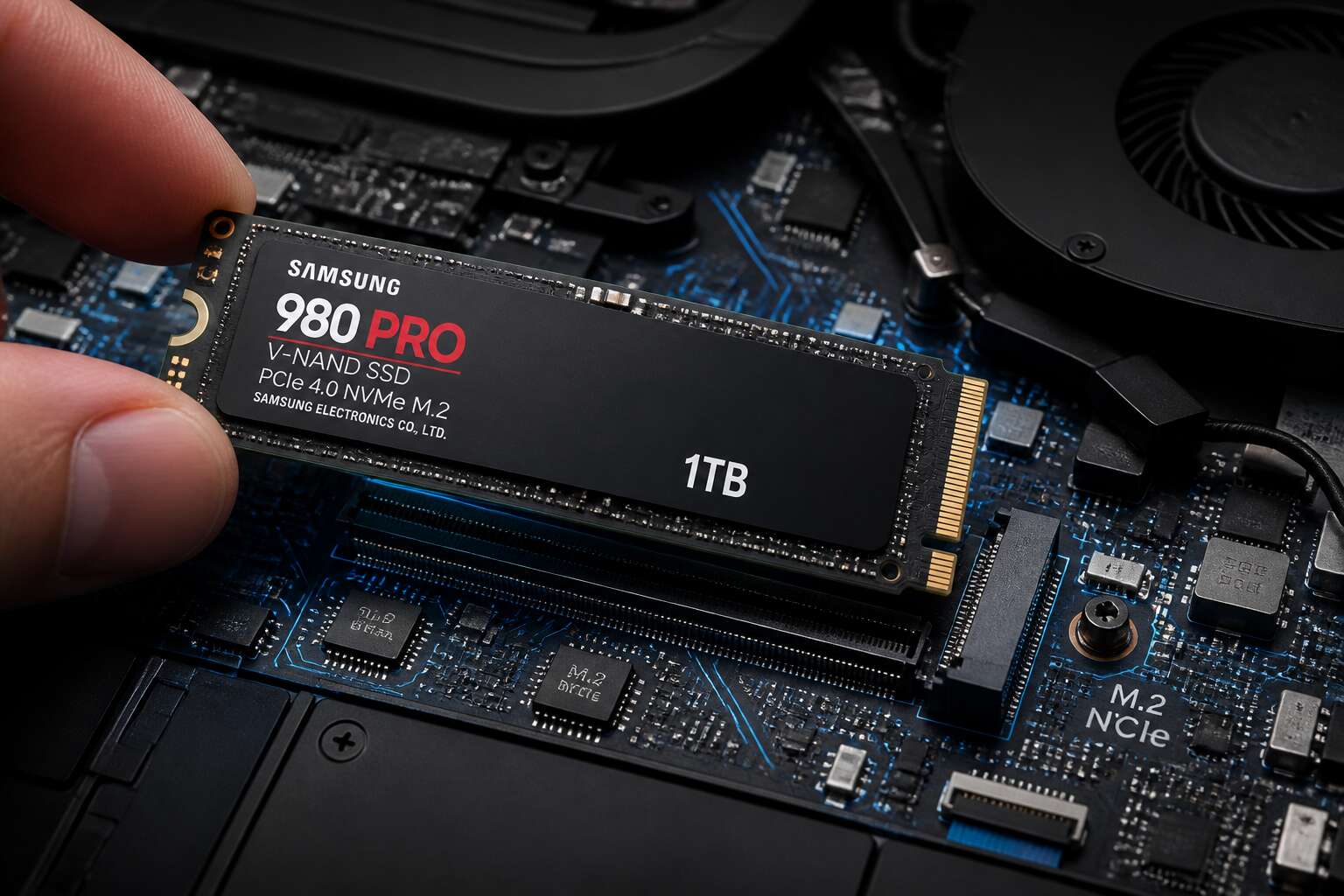
Samsung’s production strategy is straightforward. It fabricates the NAND flash, assembles the drive, and handles its own firmware and packaging. This end-to-end approach minimizes external dependencies and lets the company respond quickly to market changes. For the South African buyer, this means consistent performance across a wide range of models, from the budget-friendly 980 to the flagship 990 Pro.
It is a model of industrial self-reliance, one that other brands struggle to replicate.
Western Digital and the SanDisk Legacy
When you ask who makes nvme drives in the consumer space, Western Digital and SanDisk often appear as two names under one parent company. WD acquired SanDisk in 2016, and that brought its NAND flash fabs through a partnership with Toshiba, now Kioxia. The drives themselves show this connection. The WD Blue SN580 and SanDisk Extreme series use similar hardware, though each carries separate firmware tuning and support policies.
For South African shoppers, this means more choice at the same shelf. You might spot identical capacities and speeds under two different labels. WD targets high capacity gaming and creative workloads, while SanDisk leans portable and everyday. Both brands offer local warranty support through official distributors. A search for who makes nvme drives often returns these two names, and the answer is direct. They manufacture the silicon, assemble the drive, and handle the packaging from wafer to retail box.
Crucial by Micron: Leveraging In-House Memory
Let’s face it, when you ask who makes nvme drives, the answer often comes down to who controls the raw silicon. For consumers in South Africa, Crucial represents the most direct line to a major manufacturer without the premium branding tax. As the retail arm of Micron, one of the world’s largest memory producers, Crucial has a distinct advantage. They aren’t just slapping a label on someone else’s parts; they are vertically integrated, meaning they control the entire lifecycle of the product.
This vertical integration translates to tangible benefits on the shelf. Because Micron fabricates the NAND flash, they can bin the silicon more aggressively. This often results in competitive pricing for the South African market, where import costs can inflate hardware prices. The Crucial T500 and P3 series are prime examples of leveraging in-house memory to deliver performance that rivals more expensive competitors.
However, there is a nuance to their strategy. Crucial uses its own NAND but often relies on third-party controllers from Phison or Silicon Motion for many of its consumer models. This is a different approach compared to Samsung’s full in-house design.
– They secure the most critical component, the flash memory.
– They maintain quality control through Micron’s rigorous fabrication standards.
– They offer a reliable warranty network through local distributors like Tarsus.
For the average user in Johannesburg or Cape Town, this means you get a drive that is engineered by a memory giant, backed by a familiar brand, and often priced for real-world budgets. It is a compelling answer to who makes nvme drives that balances cost with technical pedigree.
Kingston and Seagate: Diversifying Beyond Traditional Storage
Kingston built its name on memory modules, while Seagate defined the hard disk drive era. Neither operates its own NAND fabrication plants, yet when shoppers across South Africa search for who makes nvme drives, these two brands dominate retail shelves. They succeed through different means. Kingston leverages decades of supply chain relationships to source flash at scale. Seagate applies its enterprise storage expertise to consumer drives.
Both companies invest heavily in firmware and validation. They do not control the raw silicon, but they control the final experience. This gives them flexibility to release drives tuned for specific workloads, from general productivity to high-end content creation. For the consumer, the result is choice without confusion.
- Kingston offers the KC3000 and NV2 lines across different budgets.
- Seagate positions the FireCuda series for gamers and creators.
Their market presence means a failed drive rarely requires shipping overseas. Local distributors carry stock and handle claims. That reliability matters as much as raw speeds when you consider who makes nvme drives.
The Value Segment: ADATA, Lexar, and Corsair
For most shoppers, the brand on the box matters more than the controller inside. Ask who makes nvme drives and retail answers often point to ADATA, Lexar, and Corsair. These brands compete on price and availability, not just specifications.
ADATA builds a reputation on value. Their XPG line offers solid performance for everyday users. Lexar, once known for camera memory, has shifted to SSDs with aggressive pricing. Corsair brings gaming pedigree to the table.
I see these brands as the link between raw components and everyday buyers. They purchase flash from major fabricators and pair it with third-party controllers.
- They focus on price-to-performance ratios
- They prioritize local availability and warranty support
- They release frequent firmware updates
For South African buyers, this means more options across budgets. Who makes nvme drives matters less than the trust behind the warranty.
Why Brand Owners Often Rely on Outsourced Components
It is a strange paradox. You buy a drive with a bold logo, but the brand may not have touched a single wafer. The truth is that most consumer SSD brands are master integrators, not fabricators. They design the housing, the firmware, and the marketing, but the essential silicon comes from a select group of labs in Taiwan, Korea, and Japan. This is why the question of who makes nvme drives has no simple answer.
Brand owners manage a complex supply chain. They decide on performance targets and then source controllers from Phison or Silicon Motion. They buy NAND from Kioxia or Micron. Their engineering effort goes into validation and thermal tuning, not semiconductor lithography. For the retail titans, the ownership of the final product is about trust and quality control, not raw manufacturing.
– They focus on firmware customisation to differentiate their models.
– They handle rigorous compatibility testing with major motherboards.
– They manage the logistics for global retail distribution.
– They provide the critical warranty and RMA support.
A brand like Kingston can sell more storage than some chipmakers, yet they depend on the same component supply as their rivals. The final product is a synthesis of parts. When you ask who makes nvme drives, you must understand the roles. The component foundries make the memory and controller. The brand makes the finished, reliable product you install. For South Africans, the choice hinges on confidence in that final assembly and the local support if anything fails.
Enterprise and Data Center Innovators in NVMe
Kioxia and Solidigm: The Enterprise Storage Specialists
Kioxia and Solidigm are the introverts of the enterprise storage club, quietly dominating data centers without the flashy consumer hype. When you ask who makes nvme drives for critical workloads, these two are the workhorses. Kioxia brings deep experience from its memory lineage, while Solidigm, spun from Intel’s NAND division, adds a pragmatic edge. Their enterprise SSDs prioritize endurance and power efficiency over raw benchmark bragging.
- Endurance ratings in drive writes per day
- Power loss protection for unexpected outages
- Consistent latency for database transactions
I once specced a Solidigm drive for a mining company’s server in Pretoria, and the performance stayed steady even under relentless write pressure. Both companies innovate with advanced NAND stacking, but they do so with a data center mindset. That focus matters when your uptime depends on it.
Intel’s Legacy and Optane’s Impact on NVMe
Intel once shaped the answer to who makes nvme drives. Its Optane technology used 3D XPoint memory, not NAND, to deliver latency that felt instant. I have seen systems where Optane removed bottlenecks that controllers simply could not fix.
Optane’s impact on NVMe architecture ran deeper than speed. It introduced memory-tiered storage, putting data closer to the CPU. That engineering DNA persists even after Intel stepped back from consumer drives. The protocol refinements and enterprise design principles it pioneered now guide how modern data centers handle persistent memory.
Hyperscaler Custom Designs: How AWS and Google Drive Innovation
Ask about drive manufacturing and you will hear names like Samsung or SK Hynix. However, AWS and Google now design custom NVMe controllers and firmware that suppliers build to their exact orders. I find that leverage genuinely impressive.
Hyperscalers publish public drive specifications and dictate thermal, power, and endurance limits. They tune NAND behaviour beyond what off-the-shelf components deliver for their cloud workloads. Their procurement volume decides which controller features survive in the market.
Here is what their involvement changes:
- They define interface timings for latency-sensitive cloud workloads.
- They optimise power budgets for racks running thousands of drives.
- They control firmware updates across entire fleets to suppress anomalies.
So the true answer to who makes nvme drives now includes a hyperscaler layer, while physical manufacturing remains with the established NAND vendors.
The Hidden Backbone: Contract Manufacturers and ODMs
The Role of ODMs Like Innodisk and Apacer
The question of who makes nvme drives often leads to retail packaging. Yet another layer operates beneath that surface, occupied by original design manufacturers such as Innodisk and Apacer. These ODMs assemble physical units that smaller brands later stamp with their own logos.
Innodisk builds rugged, industrial-grade storage. Apacer pairs firmware adjustment with careful component selection. Both rely on controllers from Phison or Silicon Motion and NAND from the dominant fabs. Their work includes:
- Custom firmware tuning for specific workloads
- Thermal and endurance validation of finished units
- Supply chain management amid volatile NAND pricing
For South African enterprises, this ODM layer explains why identical-looking drives carry different price tags! The label often represents a reseller, not a factory. The true answer to who makes nvme drives runs through quiet firms operating outside retail visibility.
Private Label and White-Label SSD Assembly
White label assembly explains why two different products share identical internals. A contract manufacturer orders controllers, NAND, and printed circuit boards in bulk, then assembles drives that multiple brands sell under their own names. The buyer requests a firmware configuration and packaging design.
Private label arrangements go further. The purchasing brand specifies performance targets, endurance ratings, and warranty return procedures. For South African importers, this model lowers entry barriers dramatically. A business can launch a storage brand without owning a fabrication facility!
- Smaller batches become affordable through pooled ODM purchasing power
- Regional warranty support remains the seller’s responsibility
- Component shortages affect every label equally
The question of who makes nvme drives rarely has a straightforward answer when white label products dominate budget shelves. The factory name stays hidden; the reseller’s logo gets the attention. Asking who makes nvme drives leads to a production agreement, not a household name.
The Vertical Integration Trend: Who Controls the Entire Supply Chain
The honest answer to who makes nvme drives is often a facility in Shenzhen or Taipei that no consumer has ever heard of. Contract manufacturers and ODMs run the assembly lines, negotiate component pricing, and handle firmware integration for dozens of brands simultaneously.
The vertical integration trend complicates this handoff. A few global firms now control the entire supply chain, from silicon fabrication to final packaging. They do this to protect margins and ensure supply during shortages. Smaller ODMs lose their negotiating position when these giants reserve capacity for their own product lines.
For South African importers, the practical effect is allocation. When flash memory becomes scarce, vertically integrated players ship their own drives first. White label buyers receive whatever capacity remains, at higher unit costs. The factory floor decides who makes nvme drives, but the brand on the box rarely reflects that reality.
Logistics and Availability: Forecasting Which Brands Will Last
The factory floor in Shenzhen runs twenty four hours a day, and the logistics paperwork moving through it decides which NVMe brands survive. The honest answer to who makes nvme drives appears in shipping manifests, not marketing brochures. Contract manufacturers balance wafer allocations across dozens of client brands, and a South African importer who tracks those shipments gains a serious forecasting edge.
Observing which ODMs receive priority NAND shipments reveals which brands will hold stock during shortages. Packaging factories publish capacity forecasts each quarter, and in my experience, importers who monitor these reports can predict price movements before they hit local shelves.
- Track ODM quarterly capacity reports.
- Monitor flash wafer shipping volumes.
- Compare brand allocation patterns.
Brand longevity depends on logistics relationships. A label wins when its ODM secures stable supply lines. The brands that survive supply shocks are those with binding factory contracts, not clever marketing. For South African buyers, availability reveals who makes nvme drives worth trusting.

0 Comments