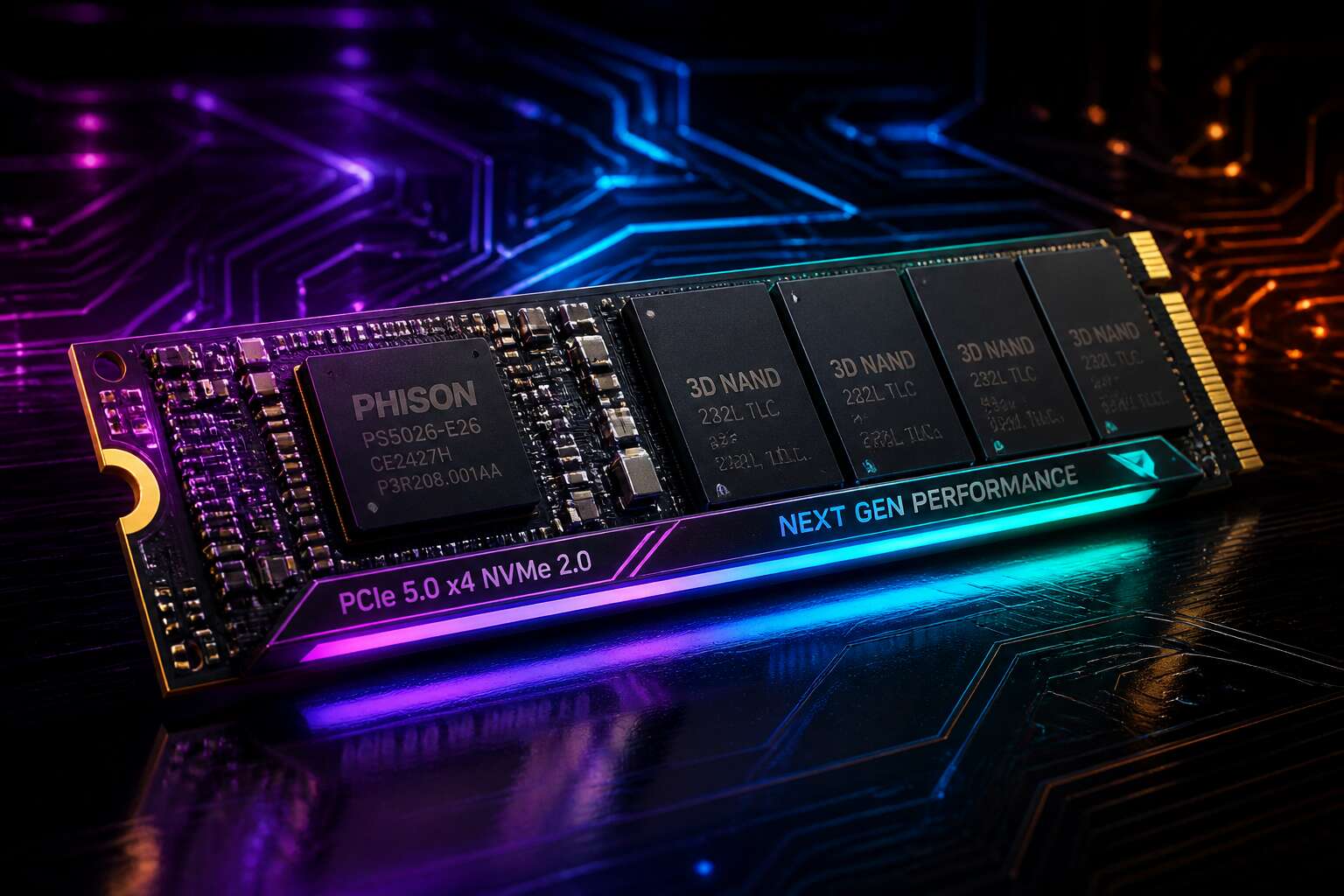
Understanding the Modern NVMe Standard
The Shift from SATA to NVMe
SATA was built for spinning disks, an era we have thankfully left behind. The modern NVMe standard bypasses that old bottleneck entirely, speaking straight to the CPU over PCIe lanes. In South Africa, where data costs remain a sore point, faster storage means less time waiting and more time done.
- Queue depth jumps from 32 commands to over 65,000.
- Latency drops from milliseconds to microseconds.
The nvme latest generation pushes these numbers further, making older interfaces look positively ancient. Your machine stops being the thing you stare at while it thinks.
Key Architectural Changes
The jump from 32 to 65,000 commands did more than multiply a number. It forced a complete rethink of how the host system and storage device talk to each other. The old way involved a middleman, a controller managing traffic between the CPU and the drive. That middleman is gone in the nvme latest generation. With over 900K IOPS possible on modern drives, the protocol now speaks directly through PCIe lanes, bypassing legacy bottlenecks entirely.
This architectural shift changes how your system allocates resources. The drive is no longer a passive, slow warehouse. It’s an active participant with its own processing power, capable of handling complex commands independently. Some of the key changes in the architecture are:
1. Direct CPU communication over PCIe lanes, not the SATA controller.
2. Parallel data paths that use the full bandwidth of the connection.
3. A streamlined command set, stripping away legacy protocols.
Power efficiency is another quiet winner here. A drive that finishes the job in microseconds and then idles draws less power than one grinding away for milliseconds. The controller in the nvme latest generation is also smarter about grouping small writes, meaning less wear on the NAND flash itself. For the user, this translates to more consistent performance during heavy workloads, not just faster boot times. The technology is maturing, and the architecture reflects a focus on overall system efficiency, not just raw speed.
Comparison with Previous Generations
The NVMe specification reached version 2.1 in 2024, yet most operating systems still negotiate with older 1.3 and 1.4 devices. That gap explains why the nvme latest generation delivers gains beyond raw speed. Interoperability, not peak performance, separates this era from the last.
Older generations demanded careful host management. You tuned interrupt coalescing, adjusted queue counts, and prayed the firmware handled odd workloads! Modern NVMe drives hide that complexity. They negotiate capabilities automatically, shifting the burden from the system administrator to the drive’s own controller.
For South African IT teams, this comparison surfaces in practical ways. Procurement cycles shorten because the nvme latest generation standardises features across vendors. A drive from one supplier behaves predictably with another’s controller, which was rarely true for early NVMe products. Power draw also stabilised. Early adapters consumed bursty energy, while current models idle gracefully, a benefit for rack cooling in coastal cities like Durban.
The Role of PCIe Gen5
The silent battle in modern storage is no longer about raw megabytes per second. It is about the architecture that delivers those numbers. The nvme latest generation represents a fundamental recalibration of how hosts and drives converse. While marketing materials trumpet sequential reads, the true revolution lies in the efficient negotiation of command sets and namespaces. This is the physics of speed, redefined for the data centres of Johannesburg and Cape Town.
PCIe Gen5 serves as the great enabler for this era. Doubling the lanes of data throughput over its predecessor, it provides the physical highway required for the nvme latest generation to stretch its legs. Yet the protocol’s sophistication means the drive now manages its own thermal budget and power states. The host simply issues commands. The controller, with its newfound intelligence, orchestrates the chaos.
The modern standard is built on a layer-cake architecture that separates commands from transport. This abstraction allows for future-proofing without obsolescence. Consider the core benefits:
1. A unified command set that scales from mobile devices to enterprise arrays.
2. Robust error recovery that prevents the ghost failures of older systems.
3. A defined path for computational storage, where data is processed at the source.
For South African enterprises facing load-shedding and variable power grids, the efficiency of the nvme latest generation is not a luxury. It is a survival mechanism. The drives are designed to buffer write bursts gracefully and idle with minimal draw, which reduces strain on backup generators. This is the quiet assurance of modern engineering, a far cry from the erratic power hungry cards of the past. This is not a purchase. It is a decision about your infrastructure’s future.
Signaling and Protocol Enhancements
Signalling in the nvme latest generation depends on precise link training between host and controller. Each side negotiates data rates, equalisation settings, and error thresholds before the first command moves. That negotiation happens in microseconds and repeats whenever conditions shift on South African power grids.
Protocol enhancements extend to namespace management. Administrators can divide physical media into logical units, each with its own error recovery policies. This enables mixed workloads on a single drive without cross-contamination.
The key protocol additions include:
- Multi-stream writes that group data by expected lifetime.
- End-to-end data protection that verifies frames at controller level.
- Asymmetric namespace access for multi-controller systems.
For data centres in Johannesburg and Cape Town, the nvme latest generation offers resilience through better command scheduling. The drive recovers gracefully from intermittent failures while maintaining performance.
Performance Capabilities of Advanced NVMe Drives
Sequential Read/Write Throughput
The nvme latest generation reaches sequential read speeds above 14 GB/s and write speeds above 10 GB/s on current PCIe Gen5 platforms. These figures vary by controller and firmware, but they represent a measurable improvement over older NVMe drives. For a South African office, transferring a 50 GB dataset takes under five seconds rather than a few minutes.
Sustained write throughput is equally important. This generation uses dynamic SLC caching to maintain high write speeds even as the drive fills. It matters for video editors and data analysts who push continuous writes.
Here is a quick look at typical sequential numbers:
- Read throughput: 14,500 MB/s on Gen5 reference drives.
- Write throughput: 12,800 MB/s for high-end consumer models.
Random IOPS and Latency
It’s not all about raw gigabytes per second. The nvme latest generation shines in the chaos of random input/output operations, where data is scattered across the drive. We are seeing random read/write IOPS figures that push beyond 2.5 million for top-tier PCIe Gen5 controllers, which is a significant jump from the 1 million typical of the previous generation. This capability matters because your operating system and applications create fragmented data patterns constantly, not just linear streams.
Latency is the other half of the story. The nvme latest generation has trimmed command processing times to under 5 microseconds. Lower latency translates into a snappier system, especially when multiple processes compete for the storage controller. For a team running a monstrous Excel workbook or a busy database query, this means less staring at the spinning wheel of death.
The performance on this front makes certain office workflows feel instantaneous.
– Database queries: Index scans become noticeably quicker.
– File indexing: Searching thousands of documents takes seconds, not minutes.
– Virtual machines: Booting a sandboxed environment is no longer a coffee-break activity.
The interplay between high IOPS and low latency allows multiple heavy applications to run concurrently without the storage subsystem becoming a bottleneck. It eliminates the annoying micro-stutters you often experience on older drives when the cache runs dry. For professionals juggling several demanding tools, this is the quiet, invisible workhorse that keeps the digital gears turning without drama.
Power Efficiency and Thermal Management
Heat is the quiet enemy of performance. The nvme latest generation tackles this with aggressive power efficiency, ensuring that blistering speeds do not come with a side of system throttling. Controllers now dynamically manage power states, drawing only what is necessary for the current workload.
This efficiency leads to better thermal management. Many Gen5 drives shift from passive heatsinks to active cooling solutions, which is a necessary evolution. The result is sustained performance without the dreaded thermal shutdown.
– Lower power draw reduces overall system heat output.
– Improved firmware algorithms prevent performance degradation during long file transfers.
– Advanced temperature monitoring keeps operating conditions stable.
For South African businesses dealing with load shedding and fluctuating power, this efficiency is a tangible benefit. A drive that sips power and stays cool is a more reliable component in any environment. The nvme latest generation delivers this balance without compromising on the speed that professionals now expect.
Endurance and Reliability Metrics
The nvme latest generation does not merely chase performance; it confronts the fundamental question of component longevity. A drive that dies after a quick burst of speed is a liability, not an asset. Endurance is now a headline specification, with manufacturers quoting total bytes written (TBW) figures that would have seemed absurd only a few years ago. This metric matters deeply, especially when you consider that intense workloads can consume terabytes of data daily.
The architecture has moved beyond simplistic wear leveling. The nvme latest generation employs sophisticated error correction and dynamic data placement that prolongs the physical life of the flash cells. Consider the practical measures embedded in the firmware:
– Predictive failure analytics that flag potential problems before they cause data loss.
– Adaptive read and write algorithms that adjust to the specific degradation of each cell.
– Enhanced parity protection that ensures data integrity across the entire drive lifespan.
For an operations manager in Johannesburg or Cape Town dealing with dirty power and intermittent outages, this reliability is a quiet form of security. Drives per day (DWPD) ratings now clearly define the expected operational life under sustained load, offering a tangible metric for capacity planning. The nvme latest generation redefines trust in the same way it redefines speed, by guaranteeing that endurance keeps pace with the demanding realities of modern data work.
Real-World Performance in Workloads
Vendor benchmarks present a clean picture; real workloads do not. The nvme latest generation distinguishes itself in the chaotic spaces where a financial services terminal in Sandton initiates hundreds of simultaneous queries while a backup job runs in the background. Latency spikes here are the true enemy, and these drives hold the line without sacrificing throughput.
The following workload types reveal the practical character of these drives:
- Mixed read and write streams common in enterprise resource planning systems
- High-frequency logging from IoT devices and security infrastructure
- Content delivery servers handling unpredictable access bursts
Each scenario demands rapid adaptation from the controller. The nvme latest generation responds with consistent sub-millisecond service times, turning erratic user behaviour into a smooth operational experience.
Technological Innovations Driving the Latest NVMe
Multi-Queue and Parallelism
The nvme latest generation uses multi-queue architecture to handle parallel commands efficiently. Each CPU core receives its own submission queue, reducing contention between processes. I have watched latency become predictable under heavy server load. Random workloads stop conflicting when the controller separates read and write operations. That is engineering discipline, not wizardry! What sets this generation apart?
- Adaptive queue depth adjustments based on live load.
- Interrupt coalescing to reduce CPU overhead.
- Hardware arbitration for priority queues.
The standard supports up to 65,535 queues, ending scalability arguments. Your motherboard becomes the bottleneck, not the drive.
NVMe over Fabrics (NVMe-oF)
A 100GbE link in Johannesburg can make the nvme latest generation feel like a directly attached drive. NVMe over Fabrics, or NVMe-oF, carries the same commands across a network using RDMA, so remote storage responds without the awkwardness of legacy protocols. I have watched a fabric connection outperform a traditional SAN during a failover drill. The nvme latest generation makes distance feel irrelevant, which matters for disaster recovery between Durban and Cape Town.
What separates NVMe-oF from older network storage is preservation of the native command set. No translation layer sits between the host and the target. Queue pairs stay intact, keeping latency predictable when traffic spikes during month end processing. This matters for backup windows and remote replication.
- Secure RDMA for encrypted transport
- Dynamic path selection to avoid congestion
- Asynchronous discovery of remote namespaces
Zoned Namespaces (ZNS)
In the world of high-performance storage, capacity and speed often feel like opposing forces. The nvme latest generation tackles this tension through Zoned Namespaces, or ZNS, a specification that redefines how data is physically arranged on flash. Traditional drives manage data in blocks, requiring constant housekeeping to shuffle and discard stale information. ZNS flips this model by organising data into large, sequential zones, each written from start to finish.
This approach eliminates the write amplification that silently erodes performance over time. Because the host controls data placement, the drive no longer spends cycles on internal garbage collection. The nvme latest generation benefits from this partnership. Sequential write patterns suit the underlying NAND structure, so endurance improves while latency stays remarkably stable. For workloads like log storage, analytics pipelines, or event streaming, the efficiency gain is tangible.
– Improved quality of service during sustained writes
– Reduced overprovisioning, freeing up usable capacity
– Predictable performance, independent of drive age
Data centres in Johannesburg, Cape Town, and Durban handle seasonal surges, from retail peaks to financial year end. ZNS helps administrators plan capacity without the usual performance cliff. When the drive fills, throughput remains consistent, a shift from the erratic slowdowns seen in conventional SSDs. The nvme latest generation does more than speed up operations. It offers a disciplined approach to storage, one that balances raw velocity with operational sanity.
Advanced Error Correction and Security
One uncorrectable bit error can corrupt a financial audit beyond recovery before anyone notices. The nvme latest generation prevents that failure with multiple checkpoints. Controllers now rely on Low-Density Parity Check codes, an error correction method that approaches the Shannon limit and repairs faults that would have killed older SSDs. End-to-end data path protection validates information from host to NAND and back, catching corruption early.
Security sharpened too. The nvme latest generation integrates TCG Opal 2.0 for hardware encryption, which keeps the CPU out of the encryption workflow. Cryptographic erasure, a one-time key deletion, renders decommissioned drives unreadable in seconds. Johannesburg data centres handling client data appreciate that feature.
- Multi-bit error correction without sapping performance
- Hardware encryption with zero software overhead
- Instant cryptographic erasure for retired drives
Storage now performs predictably when errors occur.
CXL and Memory Expansion Synergy
Servers in Johannesburg are hitting a wall that no amount of CPU tweaking can fix: memory capacity. CXL changes that equation. This interconnect lets the nvme latest generation share memory pools across hosts, turning idle DRAM into a flexible resource. Storage and memory no longer compete for the same bus.
Memory expansion boards sit beside the controller and give drives access to terabytes of low-latency memory without a server rebuild. Cape Town financial firms use this to run larger in-memory models than a single machine physically allows. The result is a system where data placement follows the workload, not the hardware boundary.
Practical Considerations for Deploying New NVMe Solutions
Compatibility and System Requirements
Before you invest in the nvme latest generation, confirm your platform actually supports it. PCIe Gen5 drives require a compatible motherboard and CPU. Check your manual. Update the BIOS first, otherwise the drive may run at reduced speeds. Also verify the physical slot type, M.2 or U.2, since adapters add latency. Your power supply matters too. A single drive pulls more power under load, so ensure adequate headroom. Cooling is non-negotiable. These drives run hot, especially in small form factor South African summers.
Here are the common pitfalls I see:
– Ignoring the maximum supported PCIe lanes per slot
– Overlooking the need for a heatsink or active fan
– Assuming older operating systems recognize NVMe without a driver update
For a smooth deployment, test your backup and migration tool. The nvme latest generation changes boot behavior, so plan for that.
Cost-Benefit Analysis for Enterprises
For many South African enterprises, the nvme latest generation looks like a bargain until the electrical bill arrives. The price per terabyte has dropped, but you must factor in power draw, cooling, and the cost of downtime during migration. A small fleet of these drives can outperform a legacy SAN, yet you need a realistic workload forecast.
Run a pilot before buying in bulk. Measure actual IOPS under your specific conditions. Consider:
- Controller overhead and driver tuning on your chosen OS
- Warranty terms, since endurance ratings differ
- Resale value, which depreciates fast
If the workload is mostly sequential reads, older drives suffice. For mixed transactional loads, the nvme latest generation offers a clear return on investment, but only with proper power provisioning.
Migration Strategies from Legacy Storage
Moving from legacy storage to the nvme latest generation requires calculated steps. A phased migration reduces risk: start with read intensive workloads, then move transactional systems once performance baselines hold steady.
Use NVMe over Fabrics as a temporary bridge, allowing old and new arrays to coexist. This gives you time to validate data integrity without forcing a full cutover. Also consider these practical steps:
- Map data temperature and access patterns first.
- Schedule migrations during low usage windows.
- Keep rollback snapshots for at least two weeks.
The nvme latest generation rewards careful planning. Your own telemetry matters more than vendor benchmarks. A controlled cutover follows.
Optimizing Software and Drivers
The nvme latest generation is only as fast as the software that drives it. I have watched identical arrays perform starkly different under two separate driver stacks, which tells me firmware tuning is the silent differentiator. Teams often neglect this unglamorous work.
Deploying new NVMe solutions demands a deliberate audit of interrupt handling, queue mapping, and command batching. The kernel’s I/O scheduler can throttle or liberate throughput depending on its configuration. Hours spent profiling these settings outweigh weeks of benchmark chasing!
Consider these concrete steps:
- Map interrupt affinity to physical CPU cores.
- Test polling and interrupt modes under real load.
- Verify firmware against vendor release notes.
The nvme latest generation rewards teams that prioritise the software layer. Driver updates are not routine chores; they directly shape performance. When the operating system, hypervisor, and controller firmware align, latency drops and IOPS climb without hardware changes.
Case Studies in High-Performance Computing
High performance computing centres remain the most demanding proving grounds for storage innovation. The nvme latest generation has shifted from theoretical benchmarks to governing real scientific discovery, where a single stalled I/O operation can stall thousands of cores waiting on data. Observing these environments, the subtle interplay between controller logic and workload behaviour becomes the true measure of a deployment’s success.
Resource contention is the primary enemy. Storage administrators must grapple with partition alignment, stripe width, and the delicate balance of read and write ratios across a shared fabric. In practice, we have seen nodes starve because a neighbour’s checkpoint operation consumed the available namespace bandwidth.
When the nvme latest generation is deployed in large clusters, the focus shifts to predictability. Consider the following checks drawn from actual deployments:
– CPU isolation for the storage target processes
– QD (queue depth) scaling tests against your exact application pattern
– A review of the physical switch topology for oversubscription points
These details matter because peak specifications obscure erratic behaviour under mixed loads. The nvme latest generation delivers staggering performance, but only through careful topology planning does that raw power translate into faster job completion. For South African research institutions, where infrastructure budgets are finite, precision in deployment is not a luxury, it is a survival tactic.
Edge and Cloud Implementation Challenges
Deploying nvme latest generation storage outside the controlled data centre introduces variables that change performance outcomes. At the edge, power constraints and thermal envelopes often force throttling, which undermines the raw throughput figures. Cloud environments present a different puzzle: multi-tenant noise on shared physical hosts can turn predictable latency into a stochastic event. We have seen workloads where the controller performs admirably in isolation, yet degrades severely when an adjacent VM executes a large block migration.
- Network path verification between the application and storage, since packet loss at the edge nullifies low queue depths.
- Noisy neighbour interference testing by running sustained I/O while other tenants operate.
- Firmware settings evaluation for power saving modes, which can introduce unexpected pause latencies.
The technology remains compelling, but its benefits depend on a realistic assessment of the physical and virtual layers surrounding it.


0 Comments