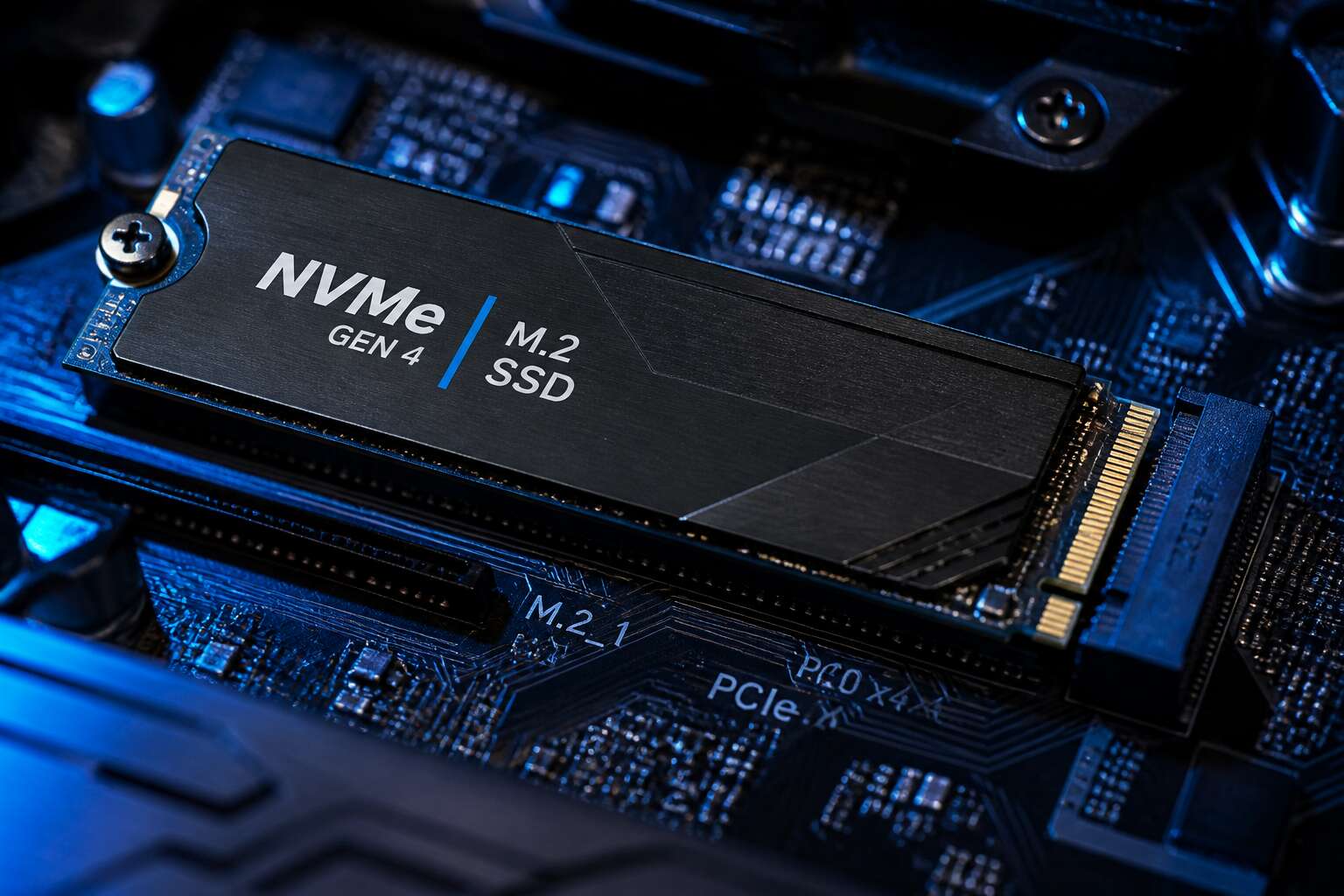
Understanding the NVMe Storage Revolution
What Is NVMe and How It Works
The storage landscape shifted quietly. NVMe, or Non-Volatile Memory Express, bypasses older SATA pathways, speaking directly to the CPU through PCIe lanes. What a shift that represents! That directness yields latency figures that once seemed mythical.
I have watched systems transform with this technology. Applications load in a blink, and the protocol’s queue depth allows dozens of simultaneous commands, a stark contrast to legacy constraints.
Here is what defines the experience:
– Sequential read speeds exceeding 3,500 MB/s
– Minimal power draw during bursts
– Thermal throttling that protects endurance
The question of when was nvme gen 4 released becomes relevant because that generation doubled bandwidth to 64 Gbps, unlocking new possibilities for creators and gamers alike.
The Long Journey from SATA to NVMe
SATA’s 600 MB/s limit persisted for fifteen years, a lifetime in computing terms. Solid state drives made that ceiling laughable, and the industry turned to PCIe. NVMe cleared the old bottlenecks, though the first generation still played it safe.
The tipping point arrived with a question: when was nvme gen 4 released. It was 2019, and the answer doubled bandwidth to 64 Gbps. That shift gave creators and gamers the headroom they needed.
- PCIe 3.0: 32 Gbps
- PCIe 4.0: 64 Gbps
What Defines a Generation in NVMe
A single NVMe generation represents a measurable change. It signals new physical layer encoding, higher bandwidth per lane, and tighter latency controls.
When someone asks when was nvme gen 4 released, they are really asking about the moment storage performance advanced. I have watched this evolution from the inside. The revolution involves more than speed. It changes how large datasets move across a system. What defines a generation in NVMe? Look at these markers:
- Signal integrity requirements
- Data throughput per lane
- Power consumption profiles
Each element shifts how system designers build motherboards and SSDs. The 2019 release of PCIe 4.0 NVMe drives altered expectations permanently.
The Origins and Development of Fourth-Generation NVMe
Early Spec Work and Industry Collaboration
The question, when was nvme gen 4 released, had an answer years before the products arrived. The NVM Express workgroup ratified the PCIe 4.0 specification in 2017, a quiet achievement that made the coming hardware possible.
That hardware depended on collaboration across three fronts:
- AMD delivered the first mainstream platform with Gen 4 support.
- Phison engineered controllers that doubled available bandwidth.
- NAND manufacturers redesigned flash memory for higher speeds.
Each group worked from the same specification, yet their timelines differed. I find it remarkable how these separate efforts aligned into a single, seamless launch!
The Role of PCIe 4.0 in Unlocking Higher Speeds
The launch of consumer drives was only half the story. The fundamental question, when was nvme gen 4 released, often ignores the architectural shift that accompanied it. PCIe 4.0 did not simply double the transfer rate; it altered the pathway between the storage device and the CPU.
This new pathway carried a significant side effect. The increased throughput introduced a new bottleneck related to latency. Queue depths that were once sufficient for Gen 3 drives suddenly became limiting factors. Engineers had to rethink how commands were processed to keep the pipeline full.
Here is what the specification changed on a technical level:
– The data rate jumped from 8 GT/s to 16 GT/s per lane.
– The encoding overhead remained at 128b/130b for efficiency.
– The maximum throughput for a four-lane connection reached 7.88 GB/s.
These parameters allowed for the use of faster NAND, but they also demanded a more robust signal integrity design. Motherboards needed thicker traces and better shielding to handle the new frequency. The architectural shift meant that caching algorithms and thermal management became as important as the flash memory itself.
The transition to PCIe 4.0 was more than a marketing milestone. It forced a redesign of the entire storage ecosystem. The standards body ratified the spec in 2017, but the real work began when the first silicon hit the market. The delays were not accidents; they were the result of ensuring that the electrical signals could survive the transition.
The software side lagged behind the hardware for a while. Operating systems and drivers took time to optimize for the new queues. The full benefits of the doubled bandwidth were not visible until firmware matured. The question of when was nvme gen 4 released has a simple answer, but the complexity surrounding its adoption remains the more interesting story. The real evolution was in the controller logic and the way data flows through the system.
The Official Release and Ratification Date
When was nvme gen 4 released? I have seen this question trip up even seasoned IT professionals. The official date arrived in January 2019, when the NVM Express consortium finalised version 1.4. Years of quiet development preceded that moment, filled with signal integrity tests and controller refinements.
Engineers spent 2018 dealing with higher frequencies and thermal loads. Consumer products only appeared after those hurdles were cleared. Here is the development timeline:
- Draft specification circulated in mid-2017.
- Validation silicon produced in late 2018.
- Retail drives shipped in mid-2019.
The release aligned with AMD’s X570 platform, which provided a stable base. That date still matters for anyone tracking storage evolution!
Early Controllers and Prototype Drives
Early fourth-generation NVMe controllers lived in laboratory test benches, not retail shelves. Prototype drives ran hot, threw errors, and demanded constant attention. Engineers spent long nights wrestling with signal integrity at PCIe 4.0 frequencies, and surviving validation meant fixing a series of embarrassing flaws.
Some of these early controllers were reworked third-generation designs. Others were entirely new silicon, built on the assumption that consumer drives could eventually deliver sequential reads beyond 5,000 MB/s. That assumption took time to prove in real-world workloads.
These prototype drives faced specific hurdles:
- Thermal throttling under sustained writes
- Electrical noise at higher data rates
- Compatibility with older motherboard slots
By the time when was nvme gen 4 released became a common search query, those early prototypes had shaped the market. The consumer products that followed owed their existence to those difficult lab experiments.
Key Specifications and Performance Gains
Sequential Read and Write Speeds
South African users frequently ask when was nvme gen 4 released, but the sequential read and write specifications reveal the true impact. Gen4 drives push sequential read speeds to 7,000 MB/s, roughly double the prior generation. Write speeds peak near 6,000 MB/s on consumer SSD models.
These numbers depend on a wider PCIe 4.0 bus and refined controllers. The drives sustain high throughput without thermal throttling in most desktop scenarios. Consider the typical Gen4 SSD parameters:
- Sequential read: 7,000 MB/s
- Sequential write: 6,000 MB/s
- Random read IOPS: over 1,000,000
The performance gains appear immediately when transferring large video files or loading game assets. While the release date answers one question, the specifications explain why Gen4 became the baseline for fast storage.
Random IOPS and Latency Improvements
Random I/O performance reveals a different side of storage than raw throughput. Gen4 drives deliver random read IOPS above 1,000,000, a leap that transforms database queries and heavy multitasking. Latency drops to under 2.8 microseconds on reads, which feels instant for applications even if the human eye cannot perceive it.
If you are still tracking when was nvme gen 4 released, the timing matters because these metrics arrived together. Early adopters saw the IOPS gains immediately, not through benchmarks alone but through snappier system behaviour.
Consider what improved:
- Queue depth scaling became far more efficient
- Power draw stayed reasonable despite higher throughput
- Mixed read and write workloads showed less performance degradation
Power Efficiency and Thermal Considerations
The PCIe 4.0 interface doubled per-lane bandwidth to 16 GT/s, but the practical gains extend beyond raw numbers. Controller architecture changed to use lower latency and higher queue depth efficiency, which improved real world performance. Knowing when was nvme gen 4 released matters because the specification set a baseline that shaped every drive released after that moment.
Power efficiency held steady despite the speed increase. Most consumer Gen4 drives consume under 8 watts under active load, with idle power dropping to nearly negligible levels. Thermal behaviour required more attention, however, because sustained writes generate heat that older enclosures struggled to dissipate. Manufacturers responded with:
- Dynamic throttling based on temperature sensors
- Redesigned heat spreaders for high capacity models
- Firmware adjustments that schedule writes during cooler phases
If you are still tracking when was nvme gen 4 released, the timing also explains these thermal curves. Gen4 drives run warmer than Gen3 predecessors, so system builders adjusted cooling strategies inside desktop cases and laptop chassis.
Backward Compatibility with Third-Generation Drives
When was nvme gen 4 released? The answer anchors the specification’s technical decisions. The PCIe 4.0 interface doubled per lane throughput to 16 GT/s, yielding 2 GB/s per lane. A standard x4 connection offered up to 8 GB/s of theoretical bandwidth, and early controllers translated that into real sustained writes.
Backward compatibility made adoption practical:
- A Gen4 drive in a Gen3 slot ran at Gen3 speeds, preserving full function.
- A Gen3 drive in a Gen4 slot worked immediately with no configuration changes.
- Firmware updates continued for both generations, so no hardware became obsolete at launch.
This design explained why drives from both generations coexisted for years after the official release. The transition was forgiving, which kept existing systems viable while newer platforms took hold. Gen3 owners could plan upgrades without pressure, and Gen4 buyers enjoyed immediate gains. The answer to when was nvme gen 4 released shaped this orderly shift in the storage market.
M.2 and U.2 Form Factor Updates
The arrival of Gen4 forced a rethinking of physical design. M.2 drives shifted from PCIe 3.0 x4 to PCIe 4.0 x4, doubling available bandwidth while retaining the same compact footprint. This let laptop makers and desktop builders adopt faster storage without altering chassis layouts. U.2 enclosures gained enterprise traction because their 2.5 inch size handles higher thermal loads and supports hot swapping.
Key specification updates included:
– M.2 length options like 2280 and 22110 for varied capacity.
– U.2 using a single cable for power and data, simplifying server cabling.
These form factor refinements mattered because when was nvme gen 4 released, it set a baseline for next generation systems.
Market Adoption and Real-World Availability
First Consumer SSDs Announced
Retail shelves finally answered the question of when was nvme gen 4 released. In August 2019, the first consumer drives from Corsair, Sabrent, and Gigabyte began appearing at major online retailers. I watched the early stock sell out within days!
The initial wave centered on a single controller, Phison’s E16, which limited variety but not enthusiasm. Buyers in South Africa faced an extra hurdle: international shipping and customs fees added another layer to an already expensive purchase.
Here is a quick look at the first announced models:
- Corsair MP600
- Sabrent Rocket 4.0
- Gigabyte Aorus NVMe Gen4
These drives proved the standard could handle real-world workloads. By the end of 2019, every major player had committed to a Gen4 roadmap. The wait for broad availability had effectively ended.
Early Adoption by Motherboard and OEM Makers
Motherboard makers moved faster than the storage industry. AMD’s X570 chipset shipped with PCIe 4.0 support in July 2019, giving early Gen4 drives a native home on retail shelves. That timing was crucial. Builders finally had a direct answer for when was nvme gen 4 released, one tied to actual purchase decisions.
OEMs like Dell, HP, and Lenovo took a slower path. They needed validated firmware and longer qualification cycles before deploying Gen4 in production laptops and workstations. Their caution made sense, though. Enterprise buyers expected predictable performance.
- ASUS and MSI updated BIOS for X570 within weeks
- Gigabyte bundled Gen4 drives with select boards
- Dell reserved Gen4 for high-end Precision models
By early 2020, the wait for motherboard and OEM support had ended. The question of when was nvme gen 4 released had shifted from announcement to adoption.
Gaming and Creator Use Cases
By mid 2020, the question of when was nvme gen 4 released had changed shape. The drives sat on retailer shelves, and prices were falling. Gamers adopted them first. Load times in open world titles dropped from minutes to moments. Creators followed once render previews and 8K timelines stopped stuttering.
Consoles embraced PCIe 4.0 next, and game engines started assuming faster storage existed.
- Steam shaders compiled faster
- Video editors scrubbed 4K timelines without proxies
- Asset streaming in Unreal Engine hit higher limits
I remember swapping a SATA drive for a Gen4 model and feeling the difference on the first boot. For most buyers, the release date had become a minor detail. What mattered was whether your motherboard had the lanes.
Price Trends and Mainstream Acceptance
By late 2020, the question of when was nvme gen 4 released had become a footnote. Retail shelves stacked with drives from Corsair, Sabrent, and WD. Prices per gigabyte dropped below the SATA premium that once made Gen4 feel like a luxury purchase.
Adoption spread through system integrators and prebuilt PCs. South African builders noticed the shift as local distributors listed Gen4 drives alongside standard options. Enterprise buyers followed, drawn by faster database reads and quicker virtual machine boots.
- Samsung 980 Pro became the default recommendation
- Budget motherboards added PCIe 4.0 support
- Windows 11 assumed NVMe storage by default
Mainstream acceptance arrived through daily use, not benchmarks. When was nvme gen 4 released no longer mattered to the average buyer. The drives sat in laptops and desktops, working without fanfare, and the generation simply became the baseline.
NVMe Gen 4 vs Gen 5 and What Comes Next
The Transition to PCIe 5.0
PCIe 5.0 arrived with twice the bandwidth of Gen 4, but the transition was never a simple switch. Knowing when was nvme gen 4 released helps explain why: controller development, firmware maturity, and platform readiness all needed time to catch up. Early Gen 5 drives launched with a familiar caveat. They ran hot, consumed more power, and offered little real-world benefit for most users.
The practical shift was more measured. South African consumers faced a choice between mature Gen 4 drives and newer Gen 5 models that promised higher sequential numbers but delivered marginal gains in everyday tasks. The real value appeared in specific workloads.
- High-end content creation with massive file transfers
- Enterprise databases and data centre storage tiers
- Gaming environments where loading times are already near-instant
By the time Gen 5 became mainstream, the release timeline had become a footnote. The generational leap was real, but the adoption curve reminded everyone that raw bandwidth rarely translates into immediate everyday performance.
Performance Jump in Fifth-Generation Drives
Knowing when was nvme gen 4 released helps frame the Gen 4 versus Gen 5 comparison, but the release date is only part of the story. Fifth-generation drives double the sequential throughput ceiling, yet everyday use rarely reaches that ceiling. Loading a game or opening a project file feels similar on both generations.
Differences show up under sustained load. Large video exports, database writes, and multi-user server tasks push Gen 5 into its stride, but they also push temperatures higher. Gen 4 drives ran warm inside a heatsink; Gen 5 drives often need active cooling to hold peak speeds, and power consumption climbs noticeably.
Looking ahead, the pattern repeats with PCIe 6.0. Controller firmware, platform support, and thermal designs arrive later than the spec sheets. South African buyers compare rising prices against marginal everyday gains.
Is Gen 4 Still Relevant Today
For most South African buyers, the question of when was nvme gen 4 released matters less than what these drives deliver today. Gen 4 remains the middle path. It offers strong sequential speeds, stable controllers, and thermals that do not demand constant attention.
Gen 5 raises the ceiling, but only specific workloads justify the added cost. Gaming loads, boot times, and everyday creative work feel nearly identical on both generations. Sustained writes and heavy server tasks benefit, yet those users must also budget for extra cooling and higher power draw.
- Gen 4 runs cooler in tight laptop chassis
- Gen 4 pricing keeps falling as Gen 5 becomes the flagship
So where does Gen 4 stand? The release date of the interface gave the ecosystem time to mature. Motherboard support is universal, firmware has been tested across countless systems, and prices suit local budgets. Gen 5 will earn its place over time, but Gen 4 still wins the value argument today.



0 Comments