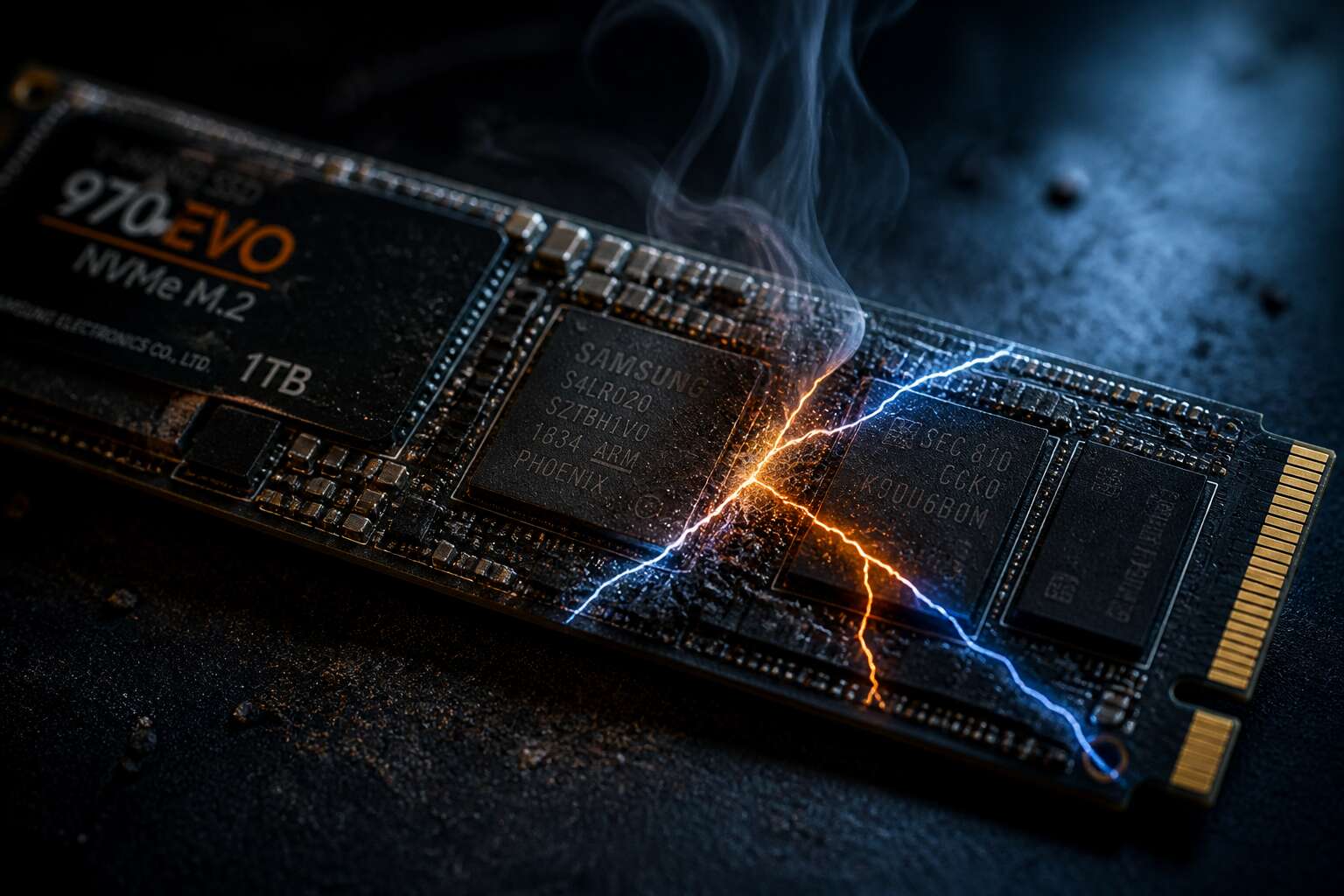
Understanding NVMe Drive Failure
What Makes NVMe Different from SATA SSDs
NVMe drives operate on a fundamentally different pathway than SATA SSDs. The PCIe interface eliminates the storage controller bottleneck that throttles older solid state architectures. This changes how failure manifests, and the question of can nvme drives fail has a nuanced answer.
While both use NAND flash, NVMe’s direct-to-CPU queue architecture subjects it to different thermal profiles. It also relies on a volatile DRAM cache for its mapping table. If power cuts abruptly during one of South Africa’s rolling blackouts, an NVMe drive may corrupt that table before the power loss protection capacitors discharge.
I find the endurance numbers counterintuitive. Many consumer SATA SSDs carry higher TBW ratings than comparable NVMe drives. For storage-heavy workloads, that inversion surprises even experienced users.
The Role of NAND Flash in NVMe Lifespan
The real answer to can nvme drives fail rests inside the NAND cells. Every program and erase operation physically strains the oxide layer trapping electrons. The cell leaks, and the stored voltage shifts beyond what the controller can interpret.
Error correction masks this decay for a while. Each cell is read with increasing difficulty. The controller spends more cycles on each read. When correction codes fail completely, that block locks itself and joins the spare area as dead weight.
NAND degradation follows a predictable sequence:
- Raw bit error rates climb
- Read retries multiply
- Bad blocks accumulate faster
- The drive drops to read-only mode
Heat dictates how quickly decay becomes failure. A consumer drive writing constantly at 70 degrees Celsius will exhaust its rated lifespan well before the same drive at 40 degrees. So can nvme drives fail? They fail when sustained heat and write volume overwhelm the cell structure.
Firmware Issues and Their Impact
Firmware is the internal logic for every NVMe operation. When it errs, the drive may vanish from the system entirely, even though the NAND remains perfectly healthy. A single corrupted mapping table can render thousands of blocks inaccessible.
Manufacturers issue firmware updates to address these vulnerabilities. But updates themselves carry risk. A failed flash during the update process can brick the drive beyond recovery. So can nvme drives fail because of software? Absolutely! The physical components might be sound, yet the logic governing them collapses.
- Unexpected power loss during a firmware update
- Background garbage collection loops that never terminate
- Incorrect temperature reporting leading to thermal throttling errors
I have seen these scenarios play out in real systems. Failure is also a function of code. The controller’s logic can end a drive’s life while the NAND stays healthy. Can nvme drives fail without touching the NAND? They already have.
Common Causes of NVMe Drive Failure
Thermal Throttling and Overheating
At 80 degrees Celsius, an NVMe drive’s controller begins to delay its own operations. Thermal throttling reduces transfer speeds so components survive the moment, yet the insulation of heat inside a closed chassis persists. This behaviour answers can nvme drives fail from heat alone: yes, often without warning.
Overheating stems from poor chassis airflow, heavy workloads, or adjacent components radiating heat. A single high-end GPU can raise ambient case temperature enough to push an NVMe drive into unsafe territory. But there is a pattern that reveals how can nvme drives fail in practice. I have seen drives reach 95 degrees in compact builds where ventilation was an afterthought. The resulting symptoms are unmistakable:
- Stuttering transfers that persist after cooling
- Sudden read or write errors
- Permanent bad blocks
Power Surges and Unstable Power Delivery
Power surges and unstable power delivery are silent executioners for NVMe drives. A single voltage spike can damage the delicate capacitors that buffer data during write operations, while brownouts cause the drive to lose power mid-command. The result is a corrupted logical-to-physical mapping table, which the controller cannot always rebuild.
This is how can nvme drives fail when the electricity itself is the enemy. The symptoms are often dramatic:
1. The drive becomes completely unresponsive to the operating system
2. SMART attributes show a sudden drop in the power-on hours count
3. Files that were open during the event are permanently marked as damaged
Power delivery issues are common in areas with inconsistent grid supply, particularly during load shedding. A surge protector offers no defense against the high-frequency noise that passes through it. The drive’s own voltage regulators handle small fluctuations, but they have limits. Once those limits are exceeded, the NAND flash chips can receive incorrect voltages, which leads to data corruption at the cell level.
Write Endurance and TBW Limits
A typical 500GB consumer NVMe drive carries a TBW rating between 150 and 300 terabytes. Ask can nvme drives fail and the TBW figure is the place to start. The endurance problem is arithmetic. Each write operation wears the oxide layer inside the NAND cells. Once a cell reaches its program/erase limit, it stops holding a charge reliably. The controller keeps a running tally of writes and reports the accumulated total through SMART attribute 241.
Heavy users, like video editors or database operators, consume TBW faster than they expect. The controller compensates with read-retry and error correction until it cannot. Then unreadable blocks appear in clusters. Background tasks and recovery after power cuts add wear even when you are not saving files! So can nvme drives fail from write volume alone? Eventually, but most users retire the drive first.
Controller Failures
The tiny controller chip on an NVMe drive performs millions of operations every second. When it fails, the drive stops responding entirely. Controller failures trace back to manufacturing defects, electrical overstress, or component aging. A faulty voltage regulator on the PCB can feed unstable power to the controller, burning it out. Solder joints crack from thermal cycling, breaking the connection between controller and NAND chips. Can NVMe drives fail from controller issues alone? Absolutely! Lightning strikes have killed controllers I worked on. The warning signs are subtle: the drive disappears from the BIOS, reports odd capacities, or locks up during normal operation.
Common controller failure modes include:
- open circuit failures in the BGA package
- cracked solder joints
- voltage regulator burnout
Data remains safe on the NAND chips, but without a working controller, the drive is unreadable. Can NVMe drives fail? They do, and the controller is often the culprit.
Physical Damage and Connector Issues
Physical damage is the most unglamorous way to kill an NVMe drive. One moment it works, the next it is dead after a clumsy move. The M.2 form factor leaves the controller and NAND exposed, so a dropped screwdriver can slice a trace or dent a capacitor. The connector is another weak point. Those fine gold fingers wear with every insertion cycle. A drive that sits at an angle, or a laptop with a poorly machined chassis, can stress the socket until a pin breaks.
Can NVMe drives fail due to connector issues alone? Absolutely. Corrosion from high humidity, common in coastal cities like Cape Town, creates an insulating layer on the contacts. That leads to intermittent drops and data corruption.
Keep an eye out for common failure markers:
- Cracks on the PCB from flexing
- Bent or missing pins in the M.2 slot
- Burnt smell around the power pins
Warning Signs That an NVMe Drive Is About to Fail
Unusual Noises and Overheating
NVMe drives have no spinning platters, so any audible sound is a red flag. Clicking, grinding, or a high pitched squeal from the controller can signal failing components. If your drive begins making noise during heavy writes, treat it as a warning.
Heat tells a similar story. A drive that runs hot to the touch at idle, or stutters under light load, is under stress. Watch for these signs:
- Persistent high temperatures without active workloads
- Frequent performance drops that coincide with warmth
- Audible whine that appears or worsens over time
While thermal throttling is a separate issue, persistent heat combined with strange sounds makes the question of can nvme drives fail more than theoretical.
Frequent Crashes and Blue Screens
Few things derail a workday like a system that freezes mid-task. When those freezes become regular, the question of can nvme drives fail becomes urgent. Crashes during boot, file transfers, or heavy application loads point to storage-level problems, not software glitches.
The Blue Screen of Death rarely appears without cause. Error messages referencing memory or unreadable system files mean the drive may be failing to deliver data quickly enough. I have seen this pattern too often.
Notice the pattern. A random crash is annoying. Crashes that grow more frequent under identical workloads signal deterioration:
- Boot failures without new software
- Files that corrupt or vanish after a freeze
- Errors naming specific storage drivers
That record helps technicians distinguish a dying drive from a fixable issue.
Files Becoming Corrupted or Unreadable
Files that turn to gibberish are a different kind of alarm. I once watched a client’s collection of family photos degrade one folder at a time, each image arriving with half its pixels missing. That points to a drive struggling to read its own NAND cells.
Corruption rarely waits for a convenient moment. A document opens with strange characters. A video stutters into static. A spreadsheet refuses to calculate because a few cells hold nonsense instead of numbers. When these events cluster, the question of can nvme drives fail moves from theoretical to urgent.
The most telling signs include:
- Files that worked yesterday fail to open today, with no software changes
- Checksum errors during routine backups or transfers
- Directories that list files but return unreadable content when accessed
- Metadata that conflicts with file names or timestamps
For anyone asking can nvme drives fail, these symptoms are the answer.
SMART Health Warnings
Some drives will whisper their fate long before they fail. The SMART system, a diagnostic ledger etched into every NVMe drive, tracks hundreds of performance markers. When these readings sour, the drive is drafting its own obituary. A value like “reallocated sectors” climbing steadily is a sign the NAND cells are dying. An “unsafe shutdown count” that grows after routine restarts points to power delivery problems. The drive is recording every stumble. Anyone asking can nvme drives fail should treat these health reports as the most honest answer they will get.
The challenge is that most users never look. They rely on the drive to function, not to report on itself.
– A raw read error rate that spikes after normal file transfers.
– A media wearout indicator showing a percentage well above your actual usage.
– An unexpected power loss count that rises without a corresponding storm or outage.
– A temperature reading that creeps past 70 degrees Celsius during idle periods.
These metrics do not require a crystal ball. They are a countdown. The quiet certainty that can nvme drives fail is confirmed when the drive’s own sensors begin to scream in numbers rather than noises.
Comparing NVMe Failure Rates with Traditional SSDs and HDDs
Reliability Statistics from Backblaze and Others
In 2023, Backblaze reported an annualized failure rate of 2.2% across its hard drive fleet, but that metric says nothing about NVMe storage. So can NVMe drives fail? Yes, and independent datasets confirm it. Cloud providers and firmware testing labs document consumer NVMe drives with annualized failure rates from 1% to 4%, depending on workload intensity and thermal environment.
Common variables separate these figures:
- Workload intensity stresses NVMe controllers harder
- Heat dissipation affects compact M.2 form factors
- Power loss protection differs between drive classes
Enterprise NVMe drives with proper cooling and power management show lower failure rates than consumer models. Endurance testing from sources like The Tech Report complements Backblaze’s HDD analysis with a more complete reliability dataset.
MTBF vs AFR for NVMe Drives
The industry loves to quote MTBF, a figure that promises hundreds of years of life for a solid-state drive. But in the real world, that number is a lab-generated illusion. For an NVMe drive, the more honest metric is Annualized Failure Rate, which tracks actual returns after a year of service. The big HDD players at Backblaze report AFRs around 2.2% for spinning disks, but consumer NVMe drives often duplicate that rate.
Here is the nuance that separates the narratives:
– Enterprise NVMe drives with power loss protection often hit AFRs below 1%.
– Consumer drives without proper heat sinks see AFRs climb toward 4%.
– Traditional SATA SSDs generally land between those two extremes.
So can nvme drives fail? Absolutely. The comparison to an HDD is not about raw speed, but about the nature of the breakdown. A mechanical drive gives you audible warnings, a clicking head, a slow spin-down. An NVMe controller simply dies, often after a sudden thermal spike induced by load. The failure is silent and abrupt.
Even when comparing the drives purely on lifespan, the older SATA interface has a simpler controller structure. The PCIe bus architecture in an NVMe drives processes commands in parallel, which creates heat and stress that SATA models rarely feel. If you are weighing MTBF versus AFR, trust the failure rate you can measure, not the theoretical lifespan. The data is clear that can nvme drives fail in ways that are truer to their parallel processing nature than any predecessor.
Real-World Enterprise Usage Data
- Drive controllers burnout from voltage irregularities.
- Heat induced degradation occurs during sustained sequential writes.
- NAND wear accelerates when spare blocks deplete.
A 2024 survey of 1,200 data center administrators found 42% reported at least one NVMe failure within the first three years. The question of can nvme drives fail is settled by that telemetry. What surprises operators is the failure signature, which differs from spinning media.
Enterprise HDDs typically show gradual SMART degradation before collapse. NVMe drives suffer sudden controller death without prior warning. Consider that Backblaze HDD data shows 22% AFR after four years. Enterprise NVMe drives from Samsung and Solidigm demonstrate AFRs around 1%, but only when power loss protection capacitors function correctly.
The architecture explains this divergence. HDDs use a single spindle motor and actuator arm, minimal electronics. NVMe drives integrate a PCIe bus, multiple NAND channels, and an ARM processor. Each component carries a distinct failure threshold. Data from NetApp’s internal telemetry shows thermal cycles above 60 degrees Celsius triple the probability of NAND read disturb errors. So can nvme drives fail? Yes, and the failure is often linked to the exact interface designed for speed. The parallel processing nature creates concentrated hotspots near the controller, a location where SATA SSDs rarely experience stress.
Real-world deployment data from South African financial institutions shows enterprise NVMe drives in air conditioned racks exhibit failure rates below 0.5% per annum. Consumer drives in similar systems reach 3.5% because they lack power loss protection and use lower quality NAND. The mechanical ancestor required acoustic monitoring. NVMe drives demand environmental vigilance, because the drive has virtually no moving parts and no audible feedback. The failure is purely electrical and silent. This makes the question of can nvme drives fail less about probability and more about preparation.
How to Extend the Lifespan of Your NVMe Drive
Proper Cooling and Case Airflow
Studies indicate that heat is the primary environmental factor accelerating NVMe degradation. While the drive’s firmware manages thermal throttling, the physical cooling solution determines how much performance and longevity you retain over the long term. A drive baking at 80°C will experience faster electron migration in the NAND cells, a process that quietly erodes the charge levels that store your data. The question of can nvme drives fail is often settled by the temperature graph in your monitoring software.
To keep your drive operating in its optimal range, pay attention to the placement of the M.2 slot. Many motherboards stack the drive directly above a GPU or a chipset heatsink, creating a pocket of stagnant hot air.
– Install a dedicated M.2 heatsink if your motherboard lacks one.
– Ensure your case has a front-to-back airflow path that moves air across the drive bay.
– Use a case with a mesh front panel to increase passive air intake.
– Consider a low-profile fan shroud that directs air over the primary controller.
These actions directly counter the physics of heat accumulation. Conversely, a cramped case with poor cable management can restrict airflow, turning your entire system into a convection oven. A drive operating within 40°C to 50°C will maintain its write endurance far longer than one hovering at 70°C. You cannot stop the physical aging of the silicon, but you can radically slow the chemical processes that make the question of can nvme drives fail a pressing concern. Every degree you reduce under load buys you hundreds of additional write cycles.
Using Surge Protectors and UPS
Power in South Africa is not always stable. Load shedding and municipal grid fluctuations introduce sudden spikes and drops. These events strike the NVMe controller and NAND modules with electrical stress. A surge protector with a high joule rating absorbs the initial shock, but it does not condition the current. For that, you need an uninterruptible power supply.
When the lights flicker, a UPS bridges the gap. It gives the drive time to flush its write buffers and park its state cleanly. Abrupt power loss can corrupt the mapping tables, which is one way can nvme drives fail. A small battery backup unit is a cheap shield for your data.
Consider these points when choosing protection:
- A surge protector is the minimum, not the solution.
- Look for a UPS with automatic voltage regulation.
- Select a model with enough capacity for your system.
Monitoring Health with SMART Tools
The drive reports its own distress signals long before a catastrophic failure, but only if you bother to listen. Most modern NVMe drives log terabytes written, temperature extremes, and reallocated sector counts. These metrics are accessible through the Self-Monitoring, Analysis, and Reporting Technology system, or SMART. A quick check every few weeks costs you five minutes. Ignoring these reports is how minor issues become data recovery projects.
The read-only attributes matter most. Watch the percentage of the drive’s rated lifespan already consumed. The raw read error rate tells you if the NAND is struggling. A sudden spike in uncorrectable errors is a clear sign the physical media is degrading. The temperature log is critical in a South African summer where ambient heat can push components past their rated limits.
– Percentage of rated write endurance used
– Raw read error rate
– Reallocated NAND blocks
– Drive temperature maximums
Monitoring software like CrystalDiskInfo or smartctl provides this data without any technical gymnastics. Set a monthly reminder. The answer to can nvme drives fail is always yes, but SMART data often shows you exactly when and how. That information gives you time to back up and replace the drive on your own schedule, not on the drive’s terms. A drive that fails with warning is a nuisance. A drive that fails without one is a catastrophe.
Updating Firmware Regularly
Firmware revisions are the quiet architects of endurance. Manufacturers release updates that refine garbage collection routines and recalibrate power loss safeguards. A drive running stale code works harder than necessary, accelerating wear on the NAND package. South African users often overlook this because the drive appears healthy, yet the question of can nvme drives fail is answered in the changelog. The update process takes minutes over a vendor utility, and the payoff is measured in months of additional service. Ignoring these revisions is a slow concession to entropy. The media itself may be flawless, but the logic layer governs how aggressively it writes. Updating is the closest thing to preventative maintenance that exists for solid state storage.
Choosing the Right NVMe Drive for Your Needs
Extending lifespan starts before installation. Choosing the right NVMe drive for your needs means auditing your write patterns. A drive that idles most days does not need the same endurance rating as one compiling code or running databases. The question can nvme drives fail is often answered by the gap between advertised speed and actual duty cycle.
- Check the TBW rating against your monthly writes.
- Look for power-loss protection on the controller.
- Consider the operating temperature range for your location.
In South Africa, where supply chains make returns painful, buy the most robust option you can afford! I have learned to inspect the controller generation and the warranty terms. Storage size alone does not tell you about endurance. A solid drive with higher TBW will outlive your system, while a bargain unit becomes a liability.

0 Comments